Visual Ethnography
Visual ethnography is a subfield of ethnography that using visual photos to document subjects' activities and surrounded context.
01 Definition
Photo studies invite the participant to photo-document aspects of his or her life and interactions, providing the designer with visual, self-reported insights into user behaviors and priorities.
---- Universal Methods of Design p.134
Visual anthropology is a subfield of social anthropology that is concerned, in part, with the study and production of ethnographic photography, film and, since the mid-1990s, new media. More recently it has been used by historians of science and visual culture.
---- Wikipedia
02 Natures
- Notes
- Image based Research: 1) visual ethnography use of photography, hypermedia (mix media) in social research camera, video record; 2) photo elicitation (p136) picture cards, personal account connect to subject’s life; 3) documentary photography: camera journal - cardio related to travel planning, study images they take
- For landscape analysis: Identify and classify the possession types, and artifact attributions within a landscape of personal possessions; Analyze the landscape ecology of each objects/artifact/possession; Identify a connected network of diverse relationships distributed across the landscape of possessions.
- Suited Context
- Good to record the activities and share to team members. It's most often used as a complementary component of other methods.
03 Procedures
- Clarify problem space and brainstorm for target subjects.
- Arrive the session field and observe the environment.
- Observe the working status of subjects.
- Introduce ourselves and ask for permission to take pictures.
- Set audio recoring and make fields.
- Inquiry about his/her working information and collect demographic information.
- Ask him/her to summarize activies related to work.
- Go over and select most representative pictures.
- Go over field notes.
- Transcribe important section of audio recording.
- Write down observations and insights from the session.
- Generate design directions based on the big picture of results.
04 Reflection
- Strengths
- There is no potential misleading caused by language barrier via the visual photo, the readers will get accurate information in short time.
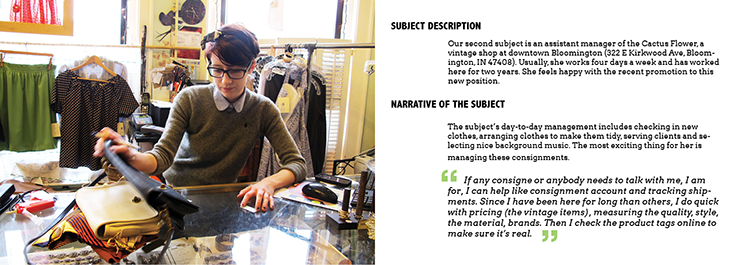
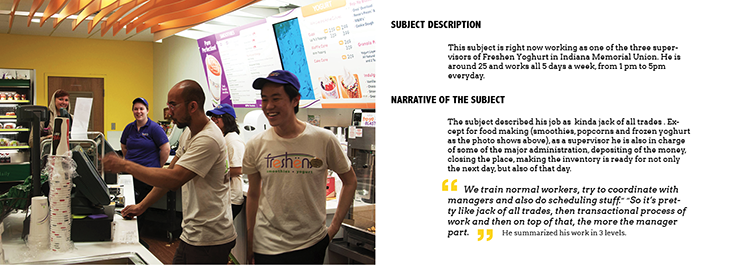
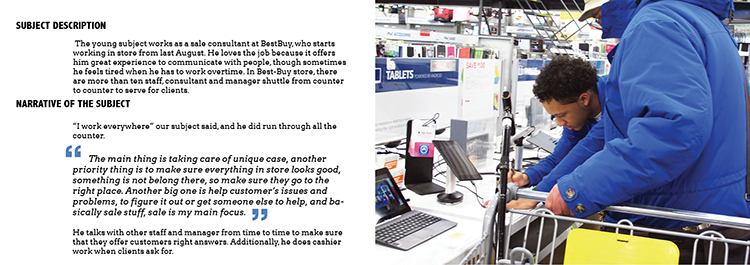
- Photos will offer much detailed information beyond words, such as their dress, tools they use and working environment, all of these are useful for researches to go deep, make relation to their job and explore insights.
- It also helps those researchers who didn’t attend the session have a more visible context.
- It is a useful method and could be used supportively to methods like contextual inquiry.
- Limitation
- The main challenge for using visual ethnography as a user research method is that taking photos, inevitably will have some influence on the performance of subjects. Chances are that they would like to act as “good subject”.
- It might be somewhat subject for researchers to choose and take pictures from their point of view. Methodologically, visual ethnography might be better integrated with other research approaches that give more power to subjects.
05 Case Document



Gengsu Tu |
Copyright © 2014 by Gengsu Tu. All rights reserved.