Genealogy and Landscape
It’s an artifact analysis method which from depth and width to explore the social and physical context of artifacts and find relations between them.
01 Definition
Rooted in the Humanities, Genealogy is a form of analysis that traces the emergence, development, and transformations of a concept, type of artifact, or practice. Landscape analysis is derived from urban design that examines relationships and configurations of a set of artifacts in a given material ecology.
---- Shaowen Bardzell
Genealogy is a method that does precisely that, namely, it investigates how certain taken-for-granted,such as scientific, truths are historical constructs that have their roots in specific social and political agendas.
---- Paula Saukko, Doing Research in Cultual Studies
02 Natures
- Notes
- Material Ecology: emphasis is placed on the extent to which an artifact participates in a system of artifacts and the possible interaction among artifacts
- For genealogy analysis: Collect family documents and stories of each artifact; Begin analysis with the present and work backward in time; Use historical records to demonstrate kinship between artifacts.
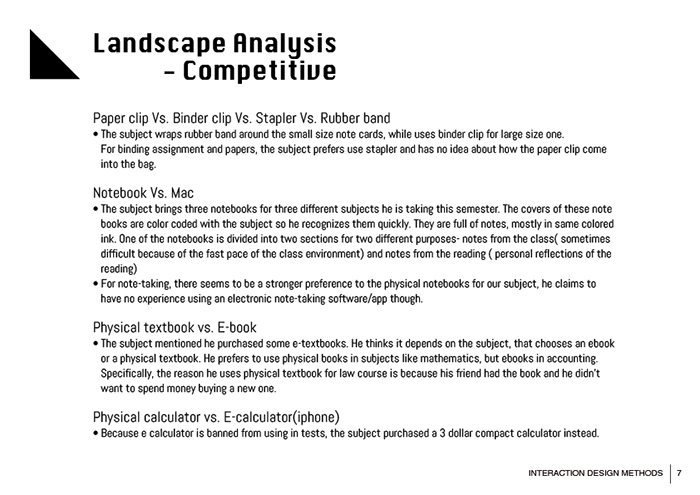
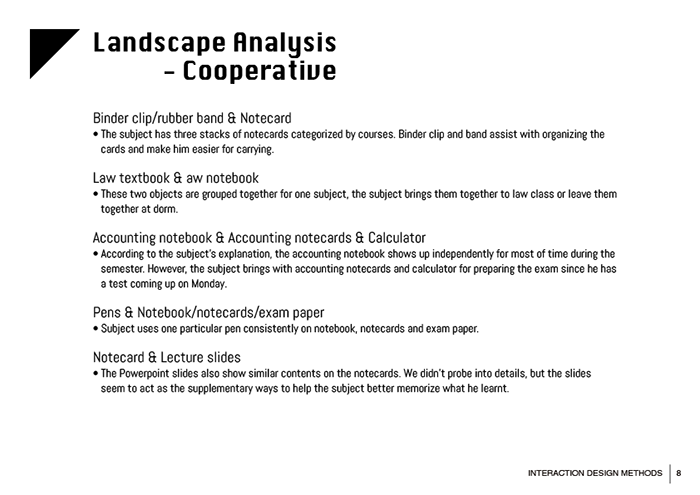
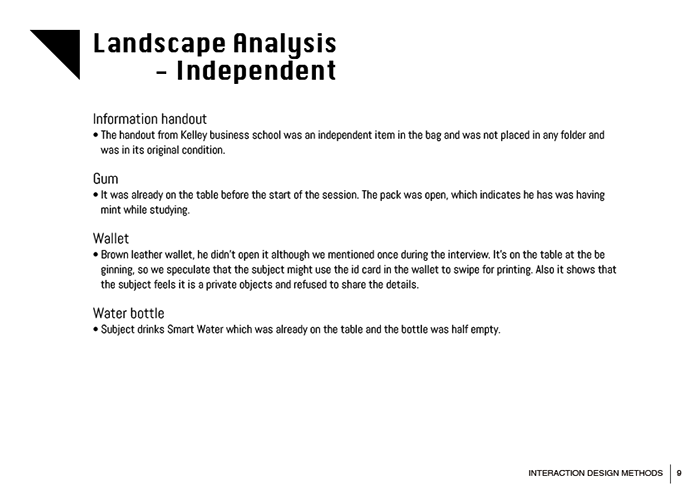
- For landscape analysis: Identify and classify the possession types, and artifact attributions within a landscape of personal possessions; Analyze the landscape ecology of each objects/artifact/possession; Identify a connected network of diverse relationships distributed across the landscape of possessions.
- Suited Context
- The patterns which are detected in landscape analysis can be used to assess the relations among personal possessions, and to review his/her personalities.
03 Procedures
- Discussed about questions(perspectives include material, purpose, source - when, where, customize, ownership, frequency of use).
- Recruited the subject.
- Introduced ourselves, the purpose of the session.
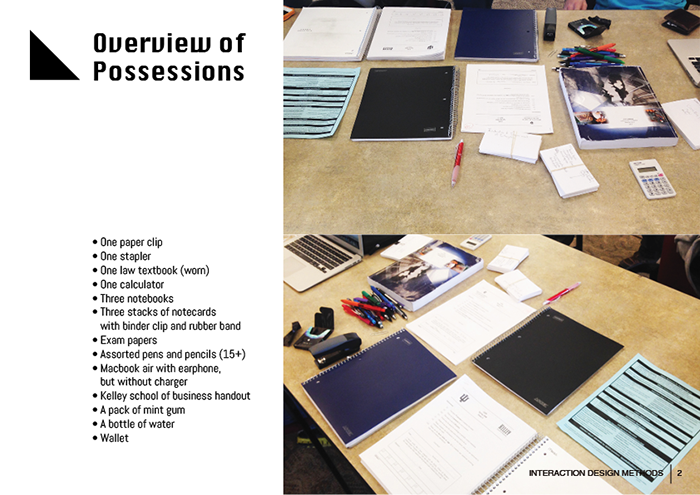
- Request him to empty bag and to arrange things in the way he likes.
- Based on question prepared, we inquired about each item.
- Recorded and photographed the whole session, including the process how he take things out of/put back to the bag.
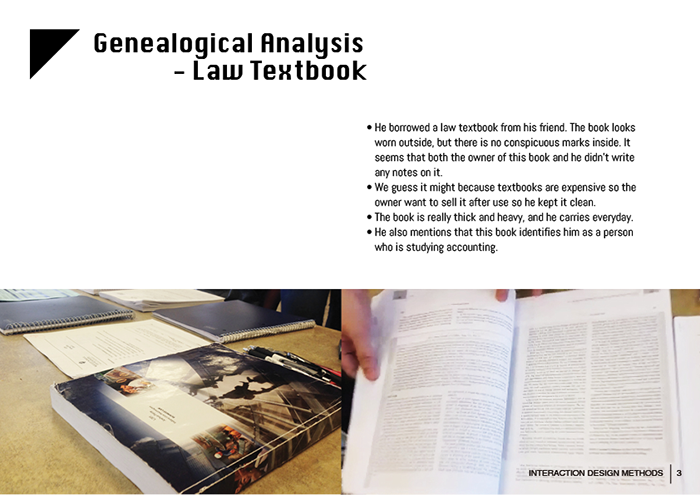
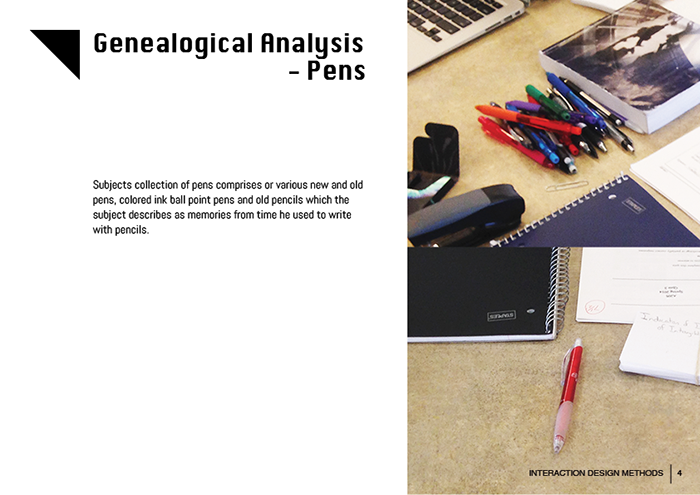
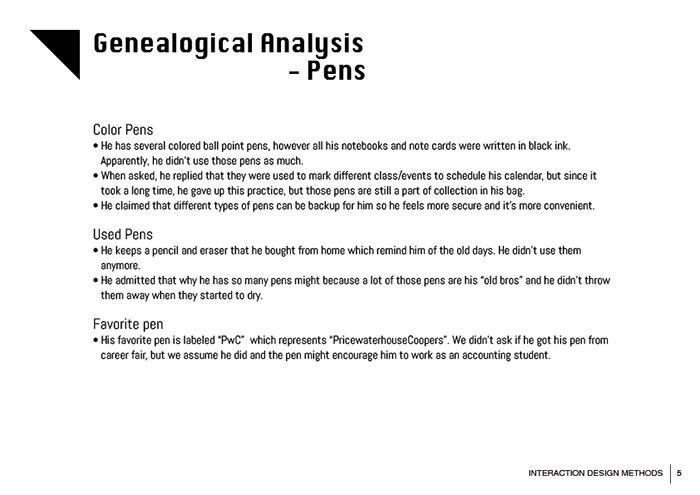
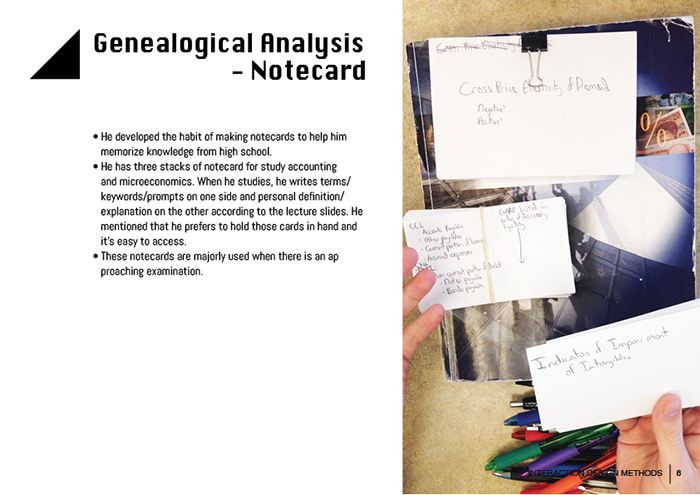
- Discussed and selected notecard, pens and the worn textbook to conduct genealogical analysis
- Construct the landscape analysis of all the content in the bag
- Collaborate analysis on Google Doc.
04 Reflection
- Strengths
- Artifacts become data through the questions posed about them and the meanings assigned to them by the researcher. There is no one right way to analyze artifacts. A wide range of disciplines informs the analysis of artifacts, including anthropology, archaeology, art history, history, human geography, ethnography, and sociology
- Limitation
- Artifact analyses are at the heart of material culture research, however it would seem that for every artifact, a specific model is often needed to adequately probe the various layers of information that an object can provide.
05 Case Document
Gengsu Tu |
Copyright © 2014 by Gengsu Tu. All rights reserved.