Final Synthesis

Within the semester, I walked through eight user research methods, and five analysis techniques. By using these multiple ways, I can reach to participants/users and understand their habit, cultural, activities and demands. Each method has particular feature adapted into different context. Under most circumstances, they should be used as collaboratively to give full play to their advantages. The website of methods notebook will be updated to involve more useful methods, as well as be placed with personal case document. It plays as a toolkit that enables me to review each method easily.
Research Methods
Research methods include Interview, Ethnography, Contextual Inquiry, Diary Study, and Cultural Probe, Visual Ethnography. I would like to arrange them in the graph by ‘’Time’’, ’’Depth’’ and how many subjects would be involved, in order to give a big picture of these methods. It is not accurate since many methods could change length and form, but the visible graph could indicate the differences between them.
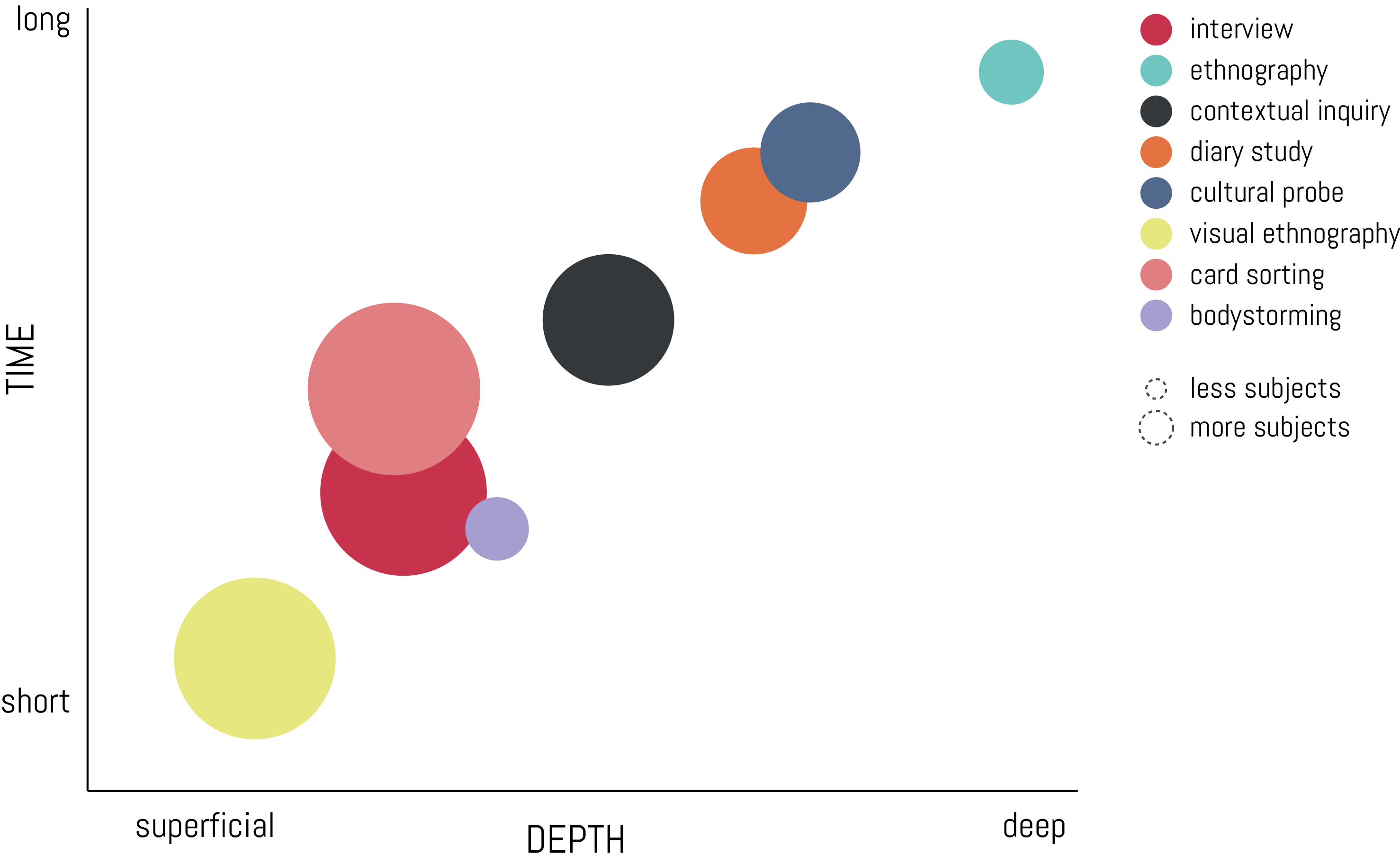
Interview is the most fundamental way since it doesn’t not time-taking but could involve more subjects effectively. It’s a very flexible method to fit into different contexts. Full-structured with narrative could be conducted very quick; while semi-structure and open-structure interviews could be developed and dug deep. Fig.2 displays the power of researcher and subject within these methods. Researcher has stronger power to conduct the interview and choose questions to make the conversation flow smoothly. So it is noticeable to avoid leading subject.
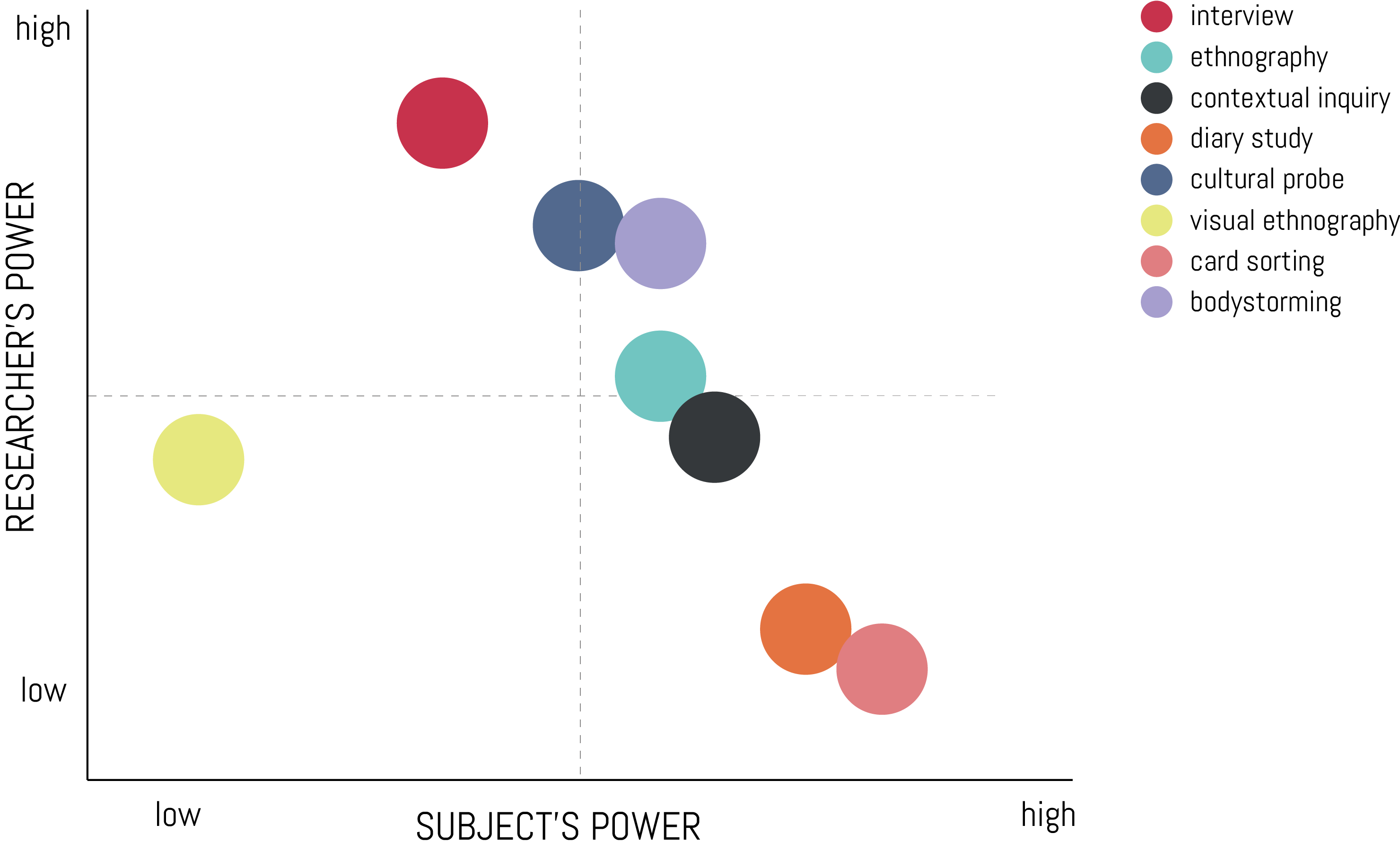
Compared with interview, contextual inquiry spares more focus on artifacts or activities and topic would be more specific and normally take longer time. It at the right middle of Fig.1, because I think it is the method with fair time-taking and fair depth. Also, since it is on the ground of master-apprentice relationship, so subject hold more power in hand, in that case, they may be fell more comfortable to show their activities and explain their mental model. Researchers still could inquiry on interesting point to get further information, so they have some power but much less then interview.
Ethnography and contextual inquiry are both immersive research methods. The difference is that ethnography engage user’s world deeply with an open mind, while the latter is narrowed to specific topics. Ethnography and contextual inquiry have similar position in Fig.2, and are relatively balanced between two powers. The study usually happens at the place where the subjects actually stay or work as opposed to some independent locations chosen by researchers. For instance, in Clutter and/or Hoarding in the Home project, Julia and I did the ethnography research at subject’s home for two hours. We raised questions based on our observation, but subject share almost equal weight in the conversation since she is in her world. To be specific, she showed us around the room for her collections, photo albums. She decided where to go, what to introduce and sometimes led the topics.
Visual ethnography, compared with interview, is relying on visual recording, so that the information is more superficial. It is useful to obtain user’s visual document quickly and share with other teammates. Researcher takes photo to record subject’s behavior and environment directly, which is revealing the ‘real’ scene. However, researcher could decide when and what to take picture, so there will be more power for him/her.
Card sorting has similar format with affinity diagram, but it ask users to arrange cards instead of researchers, it helps to generate options to structuring information from the perspective of users. It could conducts both quantitively and qualitatively. Within the process, subjects own far more power than researchers by sorting cart that make sense to them. Researchers are basically observing their activities and hearing their conversation, from which they could find out their preferences, concerns and mental model.
Bodystorming is an unique one that differs from all above methods. It is dynamic, experiential and generative. The method could be contained within design teams, but it could also involve users into the design process. The more interaction during the session, the more balanced will be between researchers and subjects.
Analysis Techniques
Analyze data is crucial after data collection, which is the process to review, organize and get insights from data. Four analysis techniques includes elito, affinity diagram, artifact analysis and genealogy and landscape. Elito and affinity diagram are more based on observation, while artifact, genealogy and landscape are grounded on objects.
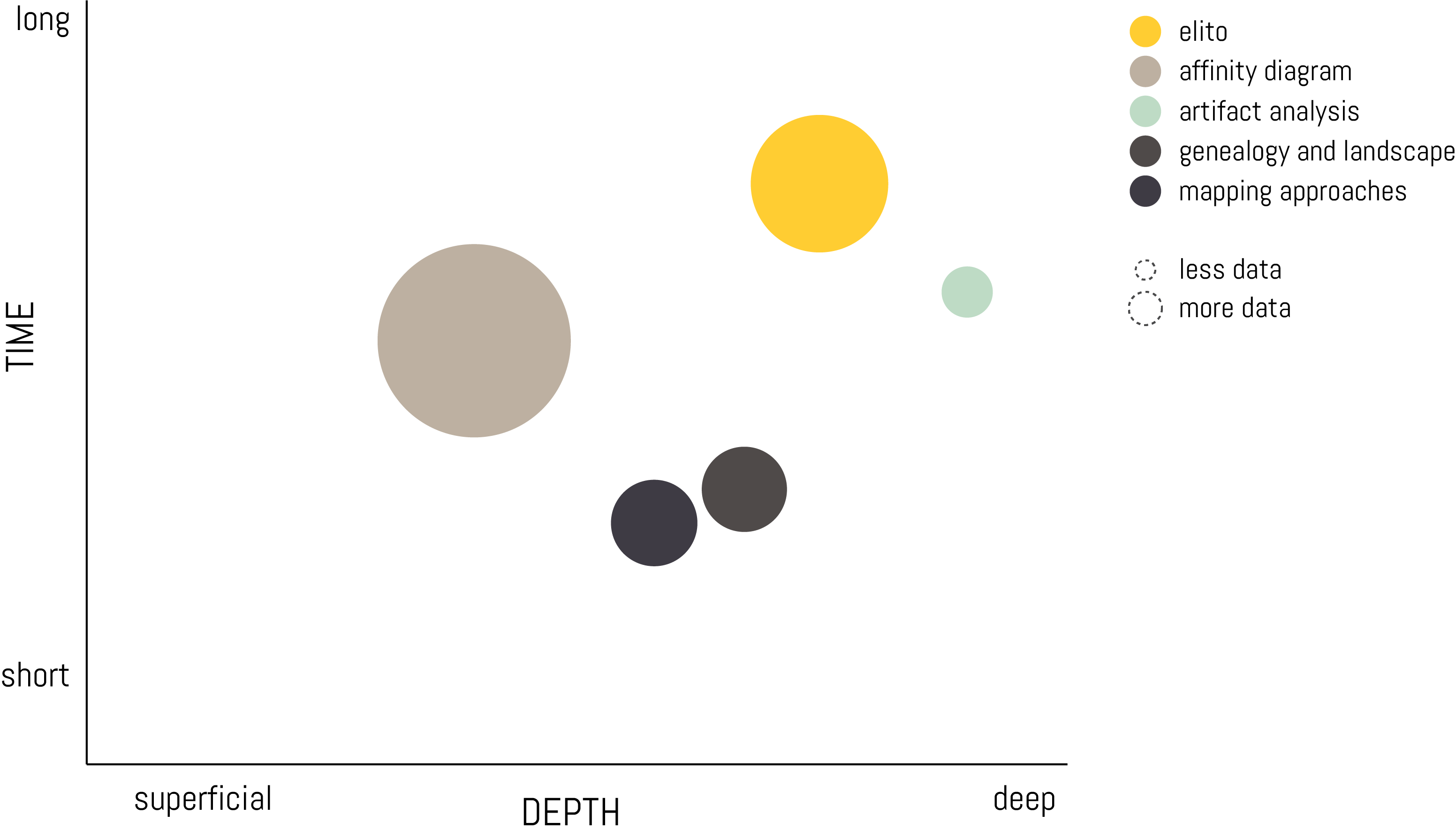
Compared to Affinity Diagram, elito requires researchers to think over details of each observation in terms of judgment, value, concept and metaphor. The logic line helps understanding the activities and forces thinking deeply. In the relevant assignment, although the process to analysis more than fifty facts is time-consuming, it is much easier when we generate concepts. The only concern of this techniques is that researchers might lost big picture when focusing on tiny details.
Affinity Diagram is more effective way to collect large scale data among team. Teammate write down all their observation on post-it notes, arrange in logical way and figure out the relation and hierarchy from them. It only takes Julia and I one hour to finish the process, and conclude labels and sub-labels for categorized groups. However, for each observation we do not go that deep as we did in elito analysis. Therefore, we takes longer time to get design insights from data.
I would like to compare artifact analysis with genealogy/landscape through the following illustrate. Artifact analysis is extremely exploratory to specific objects. Through material, construction, function, provenance and value study, the researcher could gain comprehensive information of this particular objects with understanding its cultural context.
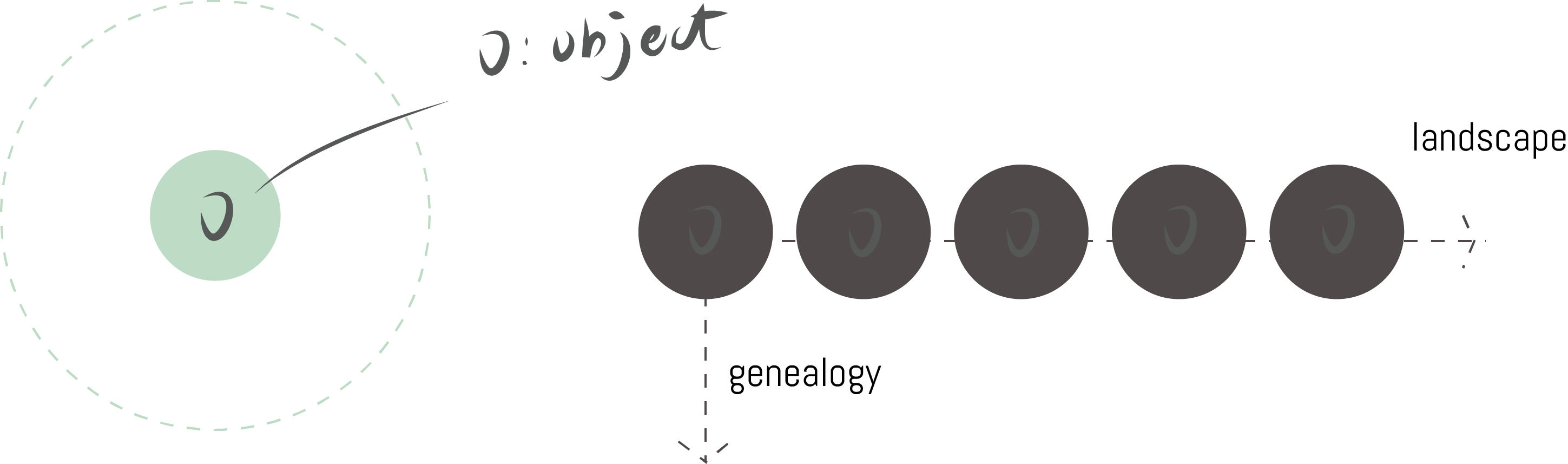
Genealogy and landscape analysis could offer a broader picture of several objects. Genealogy analysis opens up a historical channel through which researchers can see what is the origin version and how does it develop over time. Meanwhile, landscape analysis serves well in establishing the relationships between each object. In that case, it demonstrate information vertically and horizontally. On the contrary of artifact study which is relies on artifact without subject, genealogy and landscape is related to particular subject, from whom researchers could understanding why the individual owns these objects and what interactions take place between them.
Mapping approaches are divided into many types, four of them are included in this notebook: cognitive mapping, concept mapping, mind mapping and customer journey map. Through observe subject’s activities, facial expressions and self-report information (customer journey map), researchers could understand the nuances of their feelings and reflections at different moments.
Summary
In general, some research methods are easily to use to get broad data at the beginning and some of them are more useful when to dig deep to personal habit and cultural context. According to different circumstances, I will choose appropriate research and analysis methods to fit in these cases. And there won’t be absolute rule for using any of them, using them collaborative and flexible will be my principle.
Gengsu Tu |
Copyright © 2014 by Gengsu Tu. All rights reserved.