Culture Probe
It is the method that aims to elicit responses from subjects by selecting artifacts and let people interact with them. It serves as a means of gathering inspirational data about people’s lives, values and thoughts.
01 Definition
Cultural probes are provocative instruments given to participants to inspire new forms of self-understanding and communication about their lives, environments, thoughts, and interactions.
---- Universal Methods of Design p.54
Cultural probes (or design probes) is a technique used to inspire ideas in a design process. It serves as a means of gathering inspirational data about people's lives, values and thoughts. The probes are small packages that can include any sort of artifact (like a map, postcard, camera or diary) along with evocative tasks, which are given to participants to allow them to record specific events, feelings or interactions. The aim is to elicit inspirational responses from people, in order to understand their culture, thoughts and values better, and thus stimulate designer's imaginations.
---- Wikipedia
02 Natures
- Notes
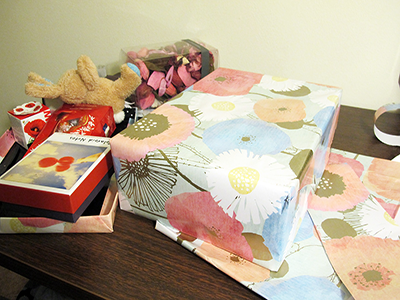
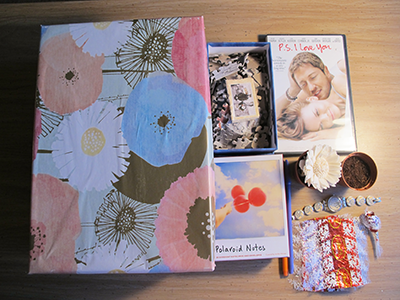
- Designed objects, physical packets containing open-ended tasks to engage users
- Explore a broad design space, spark design inspiration
- Address intimate, idiosyncratic, personal issues
- Probe Pack: Functional Aesthetics: materials are aesthetically crafted; convey personal, informal feelings; Delightful, not condescending
- Probes as packet, as data collection, participatory, sensibility
- Playfyl Triggers: goals: Use playful, ambiguous, tactile, and everyday artifacts to engage people and spark conversations; Focus on dialog-creation;Establish a bond among participants
- Suited Context
- Good when there is geographic and/or cultural distances
- Good when used on unfamiliar group
03 Procedures
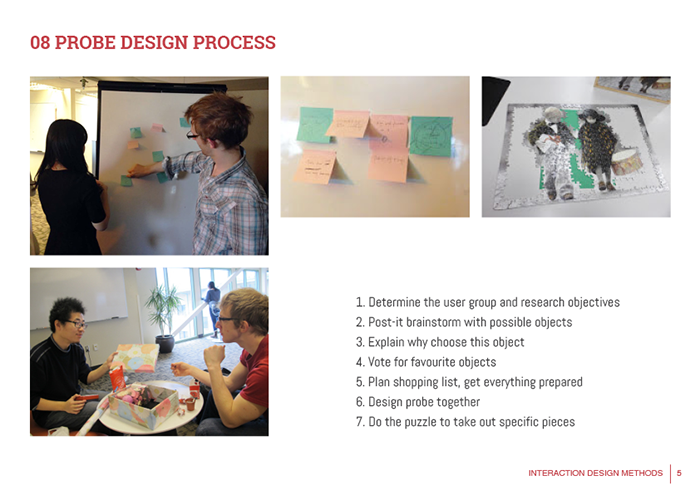
- Select a particular user group based on specific domain or problem space.
- Design the probe pack: objects and activities.
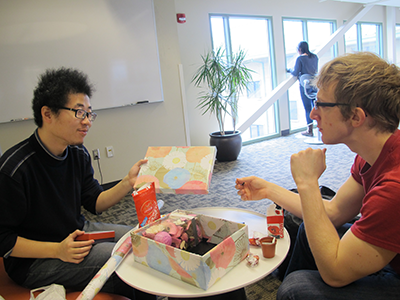
- Choose a subject and ask him/her to interact with the probe.
- Check in the middle to make sure him/her does interact with these objects and record reflections on time.
- Collect the probes and study on his/her reflection.
- Conduct follow-up interview to dig deep on key information.
04 Reflection
- Strengths
- The cultural probe provides the opportunity to understand the environmental, social, and emotional dimensions of a research space through the use of cultural artifacts, and the meaning ascribed to them by the subject.
- The types of insights gained are vague and heuristic, helping mainly to build rapport with the subject and highlight topics for future research.
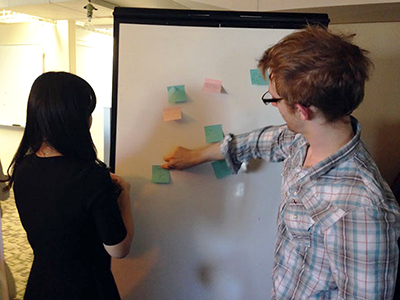
- The final process of cutting up the lines of logic helped formulate new ideas and make connections
- We had to work quickly and couldn’t dwell on making anything too perfect, leading to a low stress environment
- Limitation
- Probes are bad for getting quantified data, or otherwise clear/actionable results. The low number of subjects and peculiarity of individual interpretations makes the insights difficult to generalize with confidence.
05 Case Document
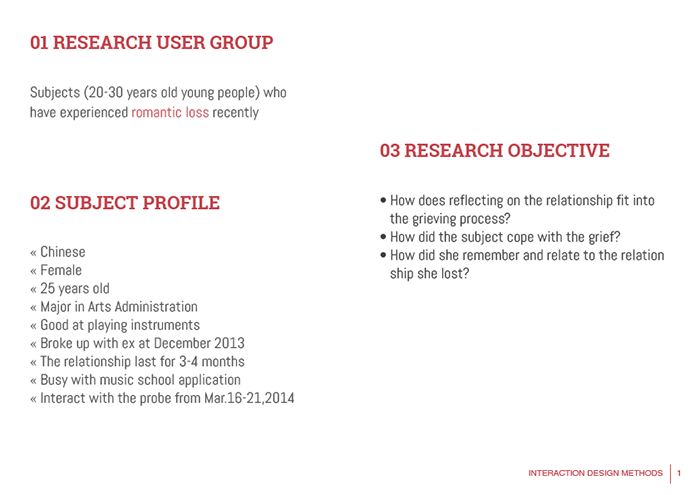
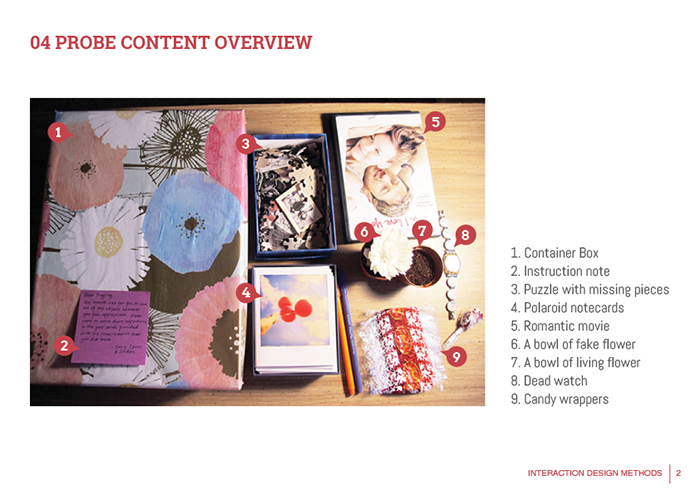
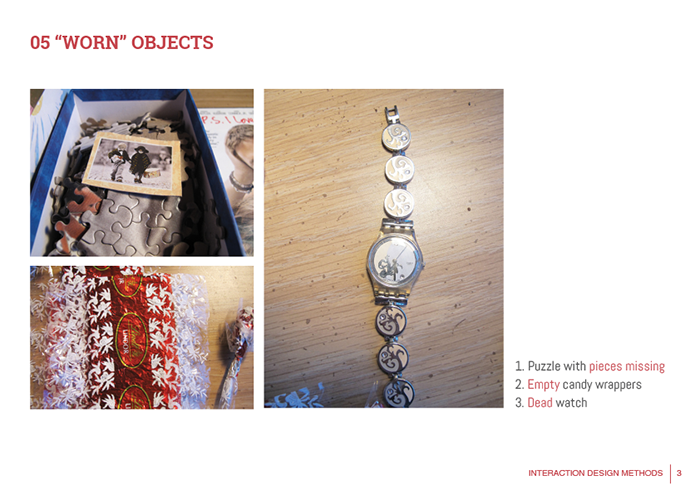
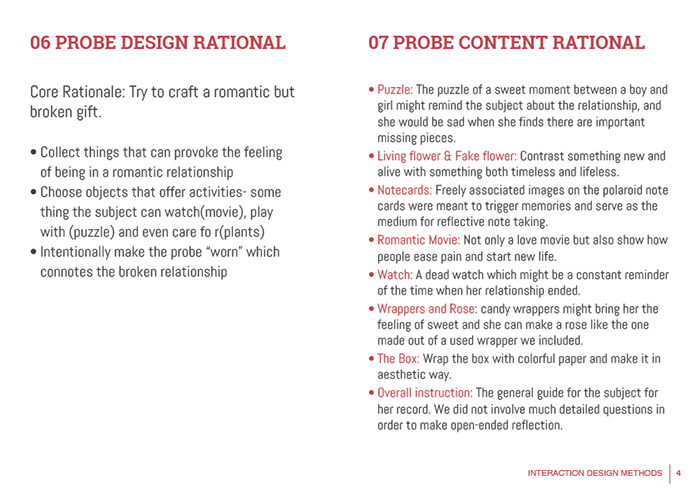
06 Supplement Reading
Gengsu Tu |
Copyright © 2014 by Gengsu Tu. All rights reserved.